Views: 0 Author: Site Editor Publish Time: 2026-10-28 Origin: Site


Tool deflection, persistent chatter, and poor surface finishes often ruin tight-tolerance parts during internal turning. These frustrating issues directly compromise part quality and drain your machining profitability. You likely face situations where standard steel and heavy metal bars simply cannot handle extreme overhangs. When you cross specific depth-to-diameter thresholds, a carbide boring bar becomes the undisputed industry standard. It provides the stiffness required to stabilize the cutting edge. Choosing the right tooling requires you to balance initial purchase costs against long-term returns. A high-quality carbide setup delivers higher cutting speeds, significantly reduced scrap rates, and superior rigidity in demanding applications. We will explore how to evaluate material properties, select proper geometries, and implement quick-change systems. You will learn actionable strategies to eliminate vibration, improve chip evacuation, and consistently achieve tight tolerances in deep holes.
The L/D Threshold: Carbide becomes strictly necessary when the Length-to-Diameter (L/D) ratio exceeds 4:1 (typically effective up to 8:1 or 10:1 depending on setup).
Rigidity vs. Brittleness: Carbide offers roughly 3x the stiffness of steel but requires highly rigid setups to prevent catastrophic tool failure from impact or vibration.
Micro-Machining Demands: Precision micro boring requires specialized geometries and internal coolant to manage chip evacuation in restricted spaces.
System Compatibility: Selecting a bar isn't just about the shank; it requires evaluating insert compatibility, clamping mechanisms, and integration with quick-change tooling blocks.
Tool deflection poses the greatest threat to dimensional accuracy during internal turning operations. In machining physics, deflection increases by the cube of the overhang. If you double the length of your tool extension, deflection multiplies by eight. The primary goal remains simple: maximize the bar diameter to increase rigidity while maintaining adequate clearance for chip evacuation. Finding this exact balance dictates whether you produce a flawless mirror finish or a tapered, chattered bore.
Selecting the right bar material directly impacts your shop's profitability. To make informed decisions, you must understand how different materials resist bending forces. We measure this stiffness using Young’s Modulus. When you evaluate a CNC lathe boring bar for internal turning, you must weigh its physical stiffness against its unit cost.
Tool Material Comparison for Internal Turning
Shank Material | Young's Modulus (Stiffness) | Effective L/D Ratio | Relative Cost | Best Application |
|---|---|---|---|---|
High-Speed Steel (HSS) | ~30 Million PSI | Up to 3:1 | Low | Light duty, short overhangs, budget projects |
Alloy Steel | ~30 Million PSI | Up to 4:1 | Low/Medium | General purpose, standard indexable turning |
Heavy Metal (Tungsten Alloy) | ~45 Million PSI | Up to 6:1 | High | Vibration damping at medium depths |
Solid Carbide | ~90 Million PSI | 8:1 to 10:1+ | Premium | Deep holes, tight tolerances, exotic materials |
Solid carbide costs significantly more upfront than steel. However, this premium price yields a highly positive ROI in specific production scenarios. If you run high-volume production cells, carbide prevents mid-batch dimensional drift. When machining exotic aerospace alloys like Inconel or Titanium, carbide resists the intense cutting forces that would instantly bend a steel shank.
You cannot look at the shank in isolation. The way an insert mounts to the bar affects your minimum bore diameter and overall strength. Screw-on clamping systems dominate small bore applications. They sit flush against the insert, eliminating bulky top clamps that would otherwise restrict chip flow in tight spaces. Clamp-style systems offer superior holding power, but they require larger starting holes.
Approach angles and clearance rules play critical roles in successful internal turning. A common mistake involves selecting an insert with insufficient relief, causing the heel of the tool to rub against the curved wall of the bore. You must calculate the bore curvature and match it with appropriate clearance angles to ensure only the cutting edge touches the workpiece.
External coolant lines rarely penetrate deep into blind holes. As the tool advances, chips pack into the bottom of the bore. The insert inevitably recuts these hardened chips, leading to instant catastrophic tool failure. Through-coolant capability stands as a non-negotiable feature for deep blind holes. Pumping high-pressure coolant directly through the bar flushes chips out of the cutting zone, lubricates the edge, and dramatically extends tool life.
Machining inside diameters under 0.250" (6mm) at extreme depths introduces a unique set of physical challenges. In miniature bores, chip clearance practically disappears. A standard coolant flush often lacks the velocity to clear debris from such a restricted annulus. You must rely on specialized geometries to manage these physics.
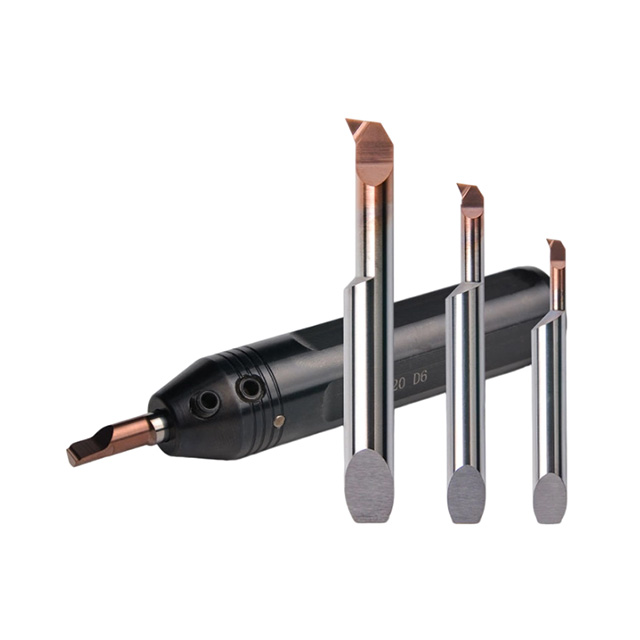
When selecting micro boring cutters for deep hole machining, you face a choice between solid carbide and indexable designs.
Solid Carbide Tools: These tools feature a cutting edge ground directly into the carbide shank. They offer the highest inherent rigidity because no screws or pockets interrupt the structural integrity. They excel in the absolute smallest diameters. However, when the cutting edge chips, you must replace the entire tool or send it out for regrinding.
Indexable Micro Bars: These utilize tiny replaceable inserts. They lower your consumable costs over time because you only replace the worn edge. The trade-off lies in physical size limits. The physical footprint of the insert screw and mounting pocket prevents indexable bars from reaching the ultra-small diameters that solid carbide tools can achieve.
Chatter destroys micro tools quickly. Because you cannot simply increase the bar diameter in a restricted hole, you must deploy alternative vibration dampening strategies. First, ensure your toolholder grips the shank across maximum surface area—use high-precision cylindrical sleeves rather than relying solely on set screws. Second, apply lighter depths of cut combined with slightly increased feed rates. This shifts cutting forces axially rather than radially, reducing the bending moment on the fragile tool neck.
Complex internal operations—like profiling, threading, and grooving—demand more than standard turning bars. These applications require specialized cutting edges and extreme dimensional stability. An internal profile boring cutter for precision micro boring tackles complex contours inside miniature cavities where conventional tools fail.
When you profile an internal groove or taper, the tool encounters varying depths and radial forces. You must carefully evaluate the neck-to-cutting-edge geometry. The neck must remain thin enough to clear complex internal features, yet robust enough to maintain the core strength of the carbide shank. A well-designed profiling tool uses a blended radius at the neck transition. This prevents stress concentrations that lead to snapping during heavy profiling passes.
Managing speeds and feeds in micro profiling requires a delicate touch. Insufficient speed causes material to tear, leaving a poor finish. However, a highly rigid carbide shank allows you to push aggressive cutting parameters. You need aggressive feeds in finishing passes to break chips effectively. If the chip does not curl and break, it wraps around the micro shank, scoring the freshly machined surface and destroying part tolerances.
High-mix, low-volume CNC shops constantly battle operational bottlenecks. Setup time and tedious tool-touch-off routines drain profitability. If your operators spend twenty minutes dialing in a tiny boring bar for every new job, your spindle remains idle, and your margins shrink.
Implementing a quick change micro boring cutter for CNC turning directly addresses these inefficiencies. You must evaluate both the benefits and the potential drawbacks of these systems.
Pros: Quick-change systems allow for sub-minute tool swaps. They offer excellent repeatability, meaning you can swap a worn tool for a fresh one without re-measuring tool offsets. This drastically reduces machine downtime and keeps your spindle turning.
Cons and Risks: These systems carry a high initial implementation cost. Furthermore, any mechanical coupling introduces a microscopic level of flexibility. You face a potential loss of absolute rigidity at the coupling interface compared to a solid tool block setup.
To make the transition to quick-change systems financially viable, you should standardize your tool shank diameters. Instead of buying custom blocks for every tool size, use precision standard sleeves and collets. Standardizing around common sizes (like 5/8" or 16mm shanks) allows you to utilize universal quick-change adapters. This strategy minimizes your upfront capital investment while maximizing flexibility across your lathe department.
Navigating tooling catalogs can feel overwhelming. To find the right tool, you need a logical framework that aligns your budget with your tolerance requirements.
Your shop environment dictates your tooling investment. For entry-level machinists, hobbyists, or light professional shops cutting low-stress materials like aluminum or brass, a budget carbide set often proves sufficient. These applications rarely test the absolute limits of the tool's rigidity.
Conversely, a production job shop cannot afford unexpected downtime. If you run multiple shifts with varying operators, you must invest in premium, brand-name, through-coolant carbide bars. High-end tools offer better edge preparation, tighter dimensional consistency, and superior coating adhesion. This reliability guarantees predictable tool life, which is essential for lights-out manufacturing.
Follow this systematic approach when selecting your next internal turning tool:
Determine the deepest hole required: Measure the maximum depth of the bore on your blueprint.
Select the largest bar diameter: Choose a diameter that comfortably fits inside the starting hole while leaving enough radial clearance for chips to escape.
Calculate the L/D ratio: Divide the hole depth by the bar diameter. If the result exceeds 4:1, immediately filter your search to solid carbide options.
Match the insert shape: Select an insert geometry based on profiling complexity. Use robust shapes like CCMT for heavy roughing, and acute shapes like DCMT or VCGT for tight corner profiling.
We encourage you to audit your current machining processes. Track your scrap rates specifically tied to internal turning chatter, out-of-tolerance bores, and poor surface finishes. When you calculate the true cost of wasted material and lost spindle time, the initial price tag of upgrading to solid carbide easily justifies itself.
Carbide boring bars represent a precision investment designed specifically to solve physical limitations in internal machining. By providing exceptional stiffness and managing deflection, they eliminate chatter and preserve critical tolerances in deep hole applications. Whether you implement solid micro cutters or adopt quick-change modular systems, upgrading your tooling strategy directly enhances your shop's productivity and part quality.
Ultimately, your tooling chain is only as strong as its weakest link. A high-quality carbide bar will only perform as well as the machine's spindle rigidity and the quality of the toolholding system securing it. Pair your premium carbide tools with rigid setups, optimal coolant delivery, and precise cutting data to unlock their full manufacturing potential.
A: You should upgrade to carbide when your Length-to-Diameter (L/D) ratio exceeds 4:1. Steel bars flex and induce severe chatter beyond this overhang. Additionally, if you continually miss tight surface finish requirements or struggle with dimensional drift in deep holes, switching to carbide provides the necessary stiffness to stabilize the cut.
A: Carbide is incredibly rigid but highly brittle. Snapping usually results from interrupted cuts, dropping the tool, or severe chatter that causes extreme harmonic vibration. Another common mistake is over-tightening set screws directly against the bare carbide shank, which creates stress fractures that fail under cutting loads.
A: While not strictly necessary for short or shallow through-holes where chips fall away naturally, through-coolant is absolutely critical for deep or blind holes. Without high-pressure internal coolant to evacuate debris, chips pack into the bore. Recutting these hardened chips will instantly shatter a brittle carbide insert.
A: Generally, no. Most micro tools rely on proprietary insert shapes and specialized clamping screws designed to fit inside severely restricted diameters. Standard ISO inserts (like CCMT or WNMG) are physically too large for miniature bores. Always verify insert compatibility with the specific micro bar manufacturer before purchasing replacements.


