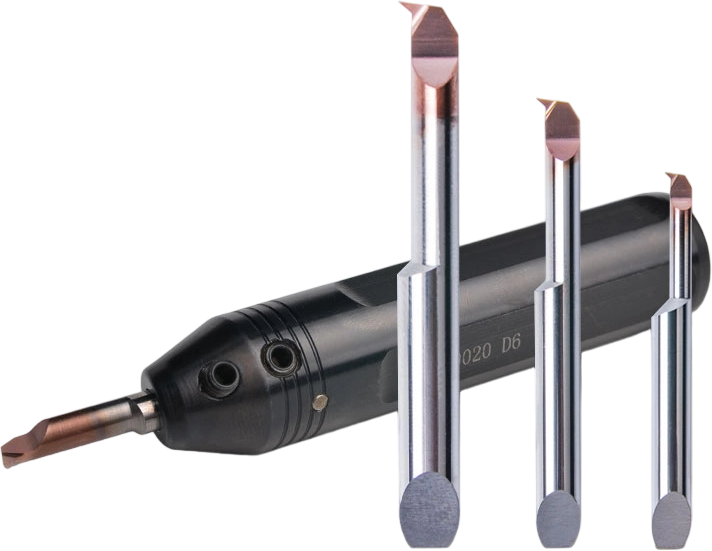
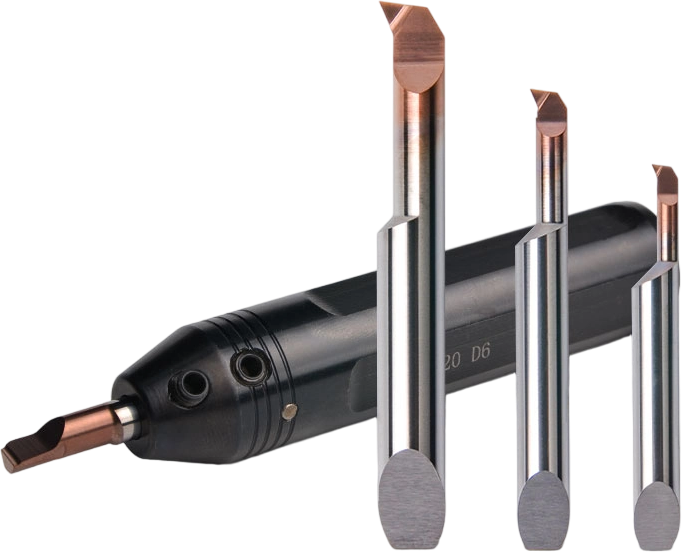
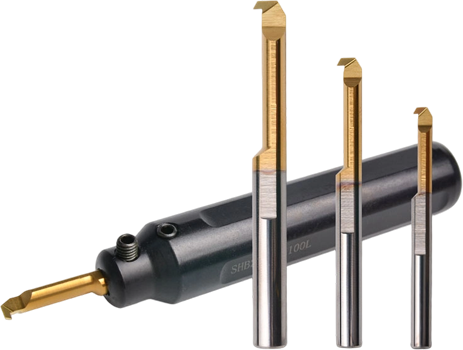
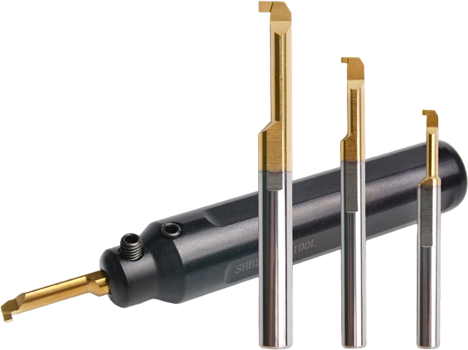
In CNC turning operations, the lathe boring tool is one of the most important cutting tools for achieving accurate internal diameters, tight tolerances, and smooth surface finishes. While drilling can create an initial hole, it cannot guarantee the dimensional accuracy or roundness required in modern manufacturing. A properly selected lathe boring tool allows machinists to precisely enlarge, correct, and finish internal holes, ensuring consistent results in industries such as aerospace, automotive, mold manufacturing, and precision engineering. For machinists and production engineers, understanding how boring tools work—and how to choose the right one—can significantly improve machining stability, surface quality, and overall productivity.
Internal machining presents challenges that differ from external turning. When a boring bar extends into a workpiece, the unsupported length of the tool increases, reducing rigidity and making the system more susceptible to vibration and deflection. Even a small amount of tool deflection can lead to tapered bores, inconsistent diameters, or poor surface finish. As a result, selecting the right lathe boring tool, optimizing tool geometry, and maintaining appropriate cutting parameters are essential steps for achieving reliable internal machining performance.
1.Understanding What a Lathe Boring Tool Does
Lathe boring tool is designed to enlarge and finish existing holes by removing material from the internal surface of a workpiece. Unlike drilling tools that create holes directly, boring tools refine the geometry of the hole to achieve greater accuracy.
In many machining processes, the typical workflow begins with drilling, followed by boring and sometimes reaming. Drilling provides the initial hole, but the hole may not be perfectly round or accurately sized. The lathe boring tool then corrects these deviations by machining the internal wall with greater precision.
Boring tools can be used for roughing or finishing operations. Rough boring removes excess material quickly, while finishing boring focuses on achieving tight dimensional tolerances and a superior surface finish. In high-precision applications, boring operations can maintain tolerances within a few microns.
Because boring operations occur inside the workpiece, tool accessibility and chip evacuation must be carefully managed. This is why the design of the boring bar plays such a crucial role in machining performance.
2.Types of Lathe Boring Tools Used in CNC Machining
Several types of boring tools are commonly used in modern machining environments. Each design offers different advantages depending on the machining requirements and workpiece geometry.
Solid Boring Bars
Solid boring bars are simple and rigid tools often used for smaller diameters. They are commonly manufactured from carbide or hardened steel and provide good stability for short overhang applications.
Solid tools are often preferred when machining small holes because they offer excellent rigidity relative to their size.
Indexable Boring Bars
Indexable boring bars use replaceable inserts rather than a fixed cutting edge. This design allows machinists to replace worn inserts quickly without replacing the entire tool.
Indexable tools are widely used in industrial production because they reduce tooling costs and improve efficiency.
Different insert geometries can also be used to optimize cutting performance for different materials.
Micro Boring Tools
When machining extremely small internal diameters, specialized micro boring tools are required. These tools are designed for small hole machining and often operate in diameter ranges below 6 mm.
Micro boring tools require exceptional rigidity and precise geometry to maintain stability during machining.
Anti-Vibration Boring Bars
Long overhang machining operations often require anti-vibration boring bars. These tools incorporate damping mechanisms that absorb cutting vibrations and stabilize the machining process.
Such tools are commonly used in deep internal machining applications where the length-to-diameter ratio becomes large.
3.Why Lathe Boring Tools Are Critical for Precision Machining
In precision manufacturing, internal hole accuracy directly affects how components fit together in mechanical assemblies. Bearings, shafts, hydraulic systems, and precision housings all rely on accurately machined bores.
A poorly machined internal hole can cause assembly problems, increased friction, or premature component failure. Because of this, boring operations are often used to achieve high levels of dimensional accuracy.
Another advantage of using a lathe boring tool is the ability to control surface finish. Proper boring techniques can produce surface finishes below Ra 1.6 μm, and in some finishing operations even finer finishes are possible.
In addition, boring operations allow machinists to correct misalignment from drilling operations. If a drilled hole deviates slightly from its intended diameter, a boring operation can bring the hole back into specification.
4.Tool Rigidity and the Importance of the L/D Ratio
One of the most important factors affecting boring performance is tool rigidity. When a boring bar extends into a hole, it behaves like a cantilever beam subjected to cutting forces.
The longer the overhang, the greater the likelihood of deflection. Even small deflections can cause dimensional inaccuracies and vibration.
This is why machinists often consider the length-to-diameter ratio (L/D ratio) when selecting a boring tool. In general machining conditions, an L/D ratio below 4:1 provides good stability. Ratios above 6:1 increase the risk of chatter.
To maintain rigidity in longer reach applications, carbide boring bars are often used because they are significantly stiffer than steel.
5.Materials Used in Lathe Boring Tools
The material used to manufacture the boring bar has a major impact on machining performance.
Carbide Boring Bars
Carbide is widely used in boring tools because it offers excellent stiffness and wear resistance. Compared with steel, carbide has a much higher modulus of elasticity, which means it deflects less under cutting forces.
For small diameter internal machining, carbide tools are often the preferred choice.
Steel Boring Bars
Steel boring bars are tougher and more impact resistant than carbide, making them suitable for larger diameter tools and heavy machining.
However, because steel is less rigid than carbide, it may not perform as well in small hole machining.
Advanced Composite Materials
Some high-performance boring tools incorporate composite materials or damping technologies that reduce vibration during machining.
These advanced tools are particularly useful for deep hole machining operations.
6.Optimizing Cutting Parameters for Boring Operations
Proper cutting parameters are essential for stable boring operations. Cutting speed, feed rate, and depth of cut must all be carefully balanced to maintain consistent chip formation.
Typical cutting speeds depend on the workpiece material. For example, when machining steel, cutting speeds may range from 80 to 150 m/min, while stainless steel may require slightly lower speeds.
Feed rates during finishing operations are usually quite small, often between 0.05 mm and 0.15 mm per revolution.
Depth of cut must also be controlled carefully. Excessive depth of cut increases cutting forces and can lead to vibration.
Maintaining stable cutting conditions helps prevent chatter and improves tool life.
7.Chip Control and Coolant Strategy
Chip evacuation is one of the most important considerations in internal machining. Because the tool operates inside a confined space, chips can easily accumulate and interfere with cutting.
If chips are not removed effectively, they may scratch the surface of the bore or damage the cutting edge.
High-pressure coolant systems are commonly used to improve chip evacuation. Coolant helps flush chips away from the cutting zone while also reducing heat buildup.
Effective chip control improves both surface finish and machining reliability.
8.Common Problems When Using Lathe Boring Tools
Even experienced machinists occasionally encounter issues when performing boring operations.
One common problem is chatter, which occurs when vibration develops between the tool and the workpiece. Chatter can create visible marks on the bore surface and reduce dimensional accuracy.
Another issue is tool wear, particularly when machining difficult materials such as stainless steel or heat-resistant alloys.
Poor surface finish may also occur if cutting parameters are not optimized or if chips become trapped inside the bore.
Understanding the root causes of these problems helps machinists adjust tooling strategies and maintain consistent machining quality.
9.How to Choose the Right Lathe Boring Tool
Selecting the correct boring tool requires evaluating several factors.
The tool diameter should be as large as possible relative to the bore size, as larger tools provide greater rigidity.
The overhang length should be minimized whenever possible to reduce deflection.
Tool material and insert geometry should match the workpiece material to ensure efficient cutting.
Machine stability also plays an important role. High-precision spindles with minimal runout are essential for achieving consistent boring results.
By carefully considering these factors, machinists can select a boring tool that delivers stable performance and long tool life.
10.Future Trends in Boring Tool Technology
As manufacturing technologies continue to evolve, boring tool designs are becoming increasingly sophisticated. Advanced coatings, improved insert geometries, and vibration-damping technologies are helping manufacturers achieve higher productivity and better surface finishes.
Digital machining technologies are also beginning to influence tool design. Some modern tooling systems integrate sensors that monitor cutting conditions and detect vibration in real time.
These innovations are helping manufacturers maintain consistent machining quality even in highly demanding applications.
11.Conclusion
The lathe boring tool remains one of the most essential tools in precision CNC machining. By enabling accurate internal machining, boring tools allow manufacturers to achieve tight tolerances, smooth surface finishes, and reliable component performance.
Understanding how boring tools work—and how to select the right tool for each application—can significantly improve machining efficiency and product quality. As industries continue to demand higher precision and more complex components, the importance of advanced boring tool technology will only continue to grow.
FAQ
What is a lathe boring tool used for?
A lathe boring tool is used to enlarge and finish existing holes in a workpiece, improving diameter accuracy and surface finish.
What is the difference between drilling and boring?
Drilling creates the initial hole, while boring improves the accuracy and geometry of that hole.
What causes chatter in boring operations?
Chatter usually occurs due to excessive tool overhang, insufficient rigidity, or incorrect cutting parameters.
Why are carbide boring bars commonly used?
Carbide provides higher stiffness than steel, which reduces tool deflection during machining.
What industries rely heavily on boring operations?
Aerospace, automotive, mold manufacturing, and heavy equipment industries frequently use boring tools for precision internal machining.