Whatsapp:+8613316488472 disir@insight-t.com
Blog
HomeBlogMicro Boring Cutters Technical Guide: Precision Parameters, Materials & Rigidity Challenges
Micro Boring Cutters Technical Guide: Precision Parameters, Materials & Rigidity Challenges
Author:Ethan Walker Release Date:2026-02-09 Views:
Contents

Introduction: Why Micro Boring Cutters Matter in Precision Machining

In ultra-precision machining, internal features often determine whether a component truly meets its functional and dimensional requirements. When bore diameters fall into the micro range and tolerances are measured in microns, standard internal tools quickly reach their limits. This is where micro boring cutters become essential. These tools are specifically engineered to enlarge, correct, and finish very small holes with high concentricity and surface quality.

In real production environments such as Swiss-type turning, medical component manufacturing, and precision connector machining, micro boring cutters are not optional finishing tools — they are accuracy-critical tools. The final bore size, roundness, and surface integrity often depend entirely on the boring stage. From an engineering and SEO content standpoint, understanding how micro boring cutters behave under real cutting conditions is key to both correct application and correct tool selection.

What Are Micro Boring Cutters and How They Are Used

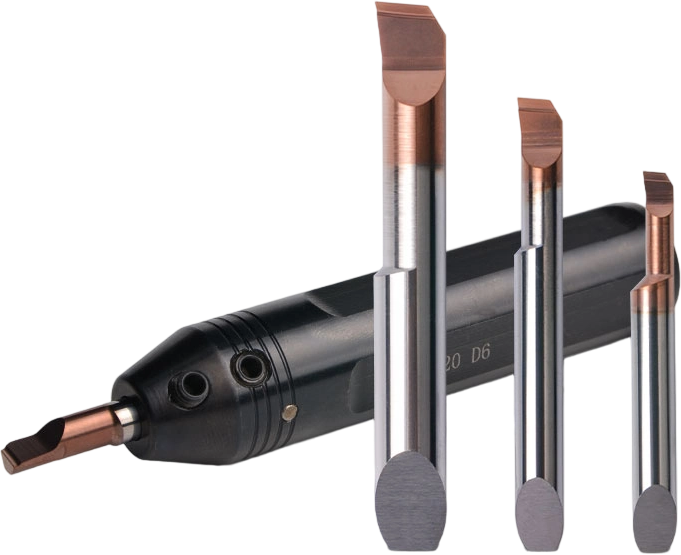
Micro boring cutters are precision internal cutting tools designed to remove a small amount of material from pre-drilled holes in order to achieve tight tolerances and fine surface finishes. Unlike drills, which primarily generate holes, micro internal boring tools refine geometry and correct deviation. They are commonly used when hole quality requirements exceed what drilling or reaming alone can achieve.

These tools are widely applied in Swiss-type lathes and small-part CNC environments where parts are dense, features are small, and tolerance stacks are unforgiving. Typical applications include medical micro components, watch parts, miniature bushings, aerospace micro features, and high-precision electronic connectors. In these sectors, a few microns of bore error can affect assembly fit or product performance.

Because micro boring cutters operate inside confined diameters, their behavior is dominated by rigidity and vibration sensitivity rather than raw cutting power. This makes their engineering and setup fundamentally different from standard boring bars.

Geometry and Precision Parameters of Micro Boring Cutters

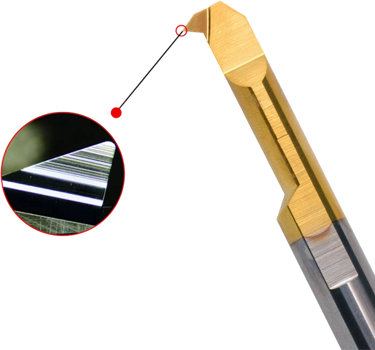
At micro scale, tool geometry becomes extremely sensitive. The cutting edge radius must be matched to the expected chip thickness. If the edge radius is too large relative to feed, the cutter will rub instead of shear, generating heat and pushing material sideways. If the edge is too sharp without sufficient support, it becomes fragile and prone to micro-chipping.

Nose radius selection also plays a major role in precision boring operations. A slightly larger nose radius can improve surface finish and edge strength, but it also increases radial cutting force. In micro hole machining, increased force quickly translates into deflection. For that reason, geometry choices are always a balance between finish quality and system stiffness.

The relationship between bore diameter and shank diameter is another critical constraint. Larger shank diameters dramatically increase stiffness, but accessibility limits how large the tool can be. In professional practice, engineers always choose the largest shank that the bore and tool path will allow. Even a small increase in shank diameter can significantly improve stability when using small diameter boring tools.

Runout tolerance is equally important. In micro boring cutters, a few microns of runout can overload one side of the cutting edge and produce uneven wear or tapered bores. Precision boring cutters must run in high-accuracy collet systems with controlled clamping force and tight concentricity. Without that, even the best tool geometry cannot perform correctly.

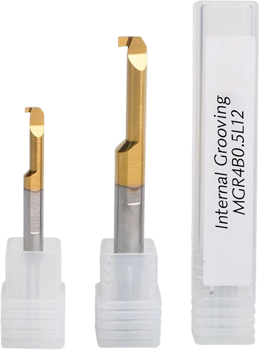
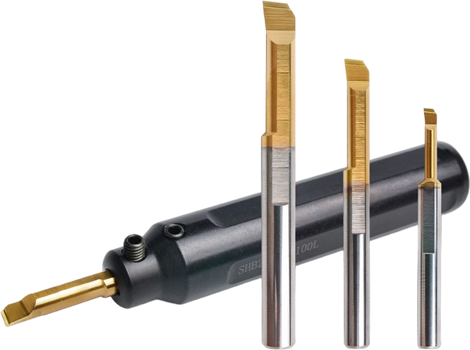
micro boring cutter

Material Selection for Micro Boring Cutters

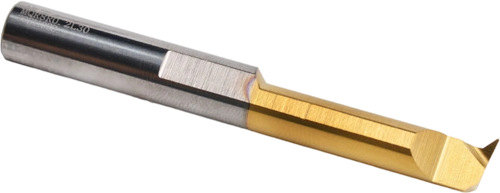
Material choice directly affects stiffness, edge retention, and wear behavior. Today, most high-quality micro boring cutters are manufactured from sub-micrograin solid carbide. Fine grain carbide provides an excellent balance between hardness and toughness, allowing sharp edges that remain stable under load. This is especially important in micro hole machining where chip thickness is minimal and edge sharpness determines whether the tool cuts or rubs.

High speed steel still appears in limited micro boring applications where additional toughness is needed, but it generally lacks the rigidity required for consistent high-precision boring operations. Tool deflection is more likely with HSS at small diameters, which limits its usefulness in production settings.

Some designs use carbide-lined or brazed-tip constructions. These combine a steel shank for vibration damping with a carbide cutting edge for wear resistance. In setups where machine rigidity is not ideal or overhang cannot be reduced further, this hybrid approach can provide more stable performance.

Coating selection must be handled carefully. While coatings improve wear and heat resistance, they also increase edge thickness. In micro boring cutters, thick coatings can reduce sharpness and increase cutting forces. Low-friction and thin-film coatings are typically preferred, especially for non-ferrous materials and fine finishing passes.

Rigidity Challenges in Micro Boring Operations

Rigidity is the dominant limiting factor in all micro boring operations. Because the tool cross section is small, deflection increases quickly as overhang grows. The mechanical relationship is not linear — deflection rises sharply with length. This means that reducing projection by even a small amount often produces a noticeable improvement in bore stability and finish.

Vibration sources are not limited to the cutter itself. They can originate from spindle bearings, turret interfaces, holder systems, or clamping distortion. Micro boring cutters respond immediately to these dynamic effects because their stiffness margin is small. What appears to be a cutting parameter problem is often a structural rigidity problem.

Machine type also influences results. Swiss-type lathes typically provide better support conditions due to guide bushings located close to the cutting zone. This reduces unsupported tool length and improves stability in precision boring operations. However, even on Swiss machines, holder accuracy and collet quality remain decisive factors.

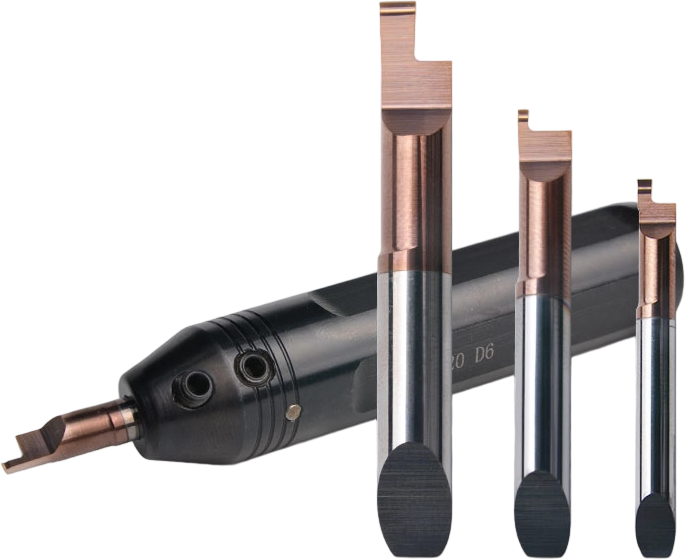
micro boring tool

Chip Control and Thermal Effects in Micro Hole Machining

Chip evacuation becomes more difficult as bore diameters shrink. Micro holes restrict chip flow, and packed chips generate heat and edge damage. In deep micro bores, chip congestion is one of the most common hidden causes of tool failure.

Coolant strategy plays a major role in process stability. Directed high-pressure coolant improves chip evacuation and reduces thermal variation. Through-tool coolant delivery is particularly effective when available. In some cases, staged or peck-style boring cycles are used to periodically clear chips, even when total stock removal is small.

Thermal effects should not be underestimated. Because tolerances are tight, small temperature shifts in the tool, holder, or workpiece can influence final bore size. Stable coolant flow and consistent cycle timing help maintain dimensional repeatability.

Cutting Parameters and Setup Strategy

Micro boring cutters generally perform best under conservative cutting strategies. Spindle speeds are often relatively high due to small diameters, but feed per revolution remains low to maintain proper chip thickness. Aggressive feed increases tend to trigger instability quickly rather than gradually.

Depth of cut is usually divided into multiple passes. A light roughing pass followed by one or two controlled finishing passes produces better geometry than a single heavier cut. This approach reduces radial force and tool deflection, improving roundness and size control.

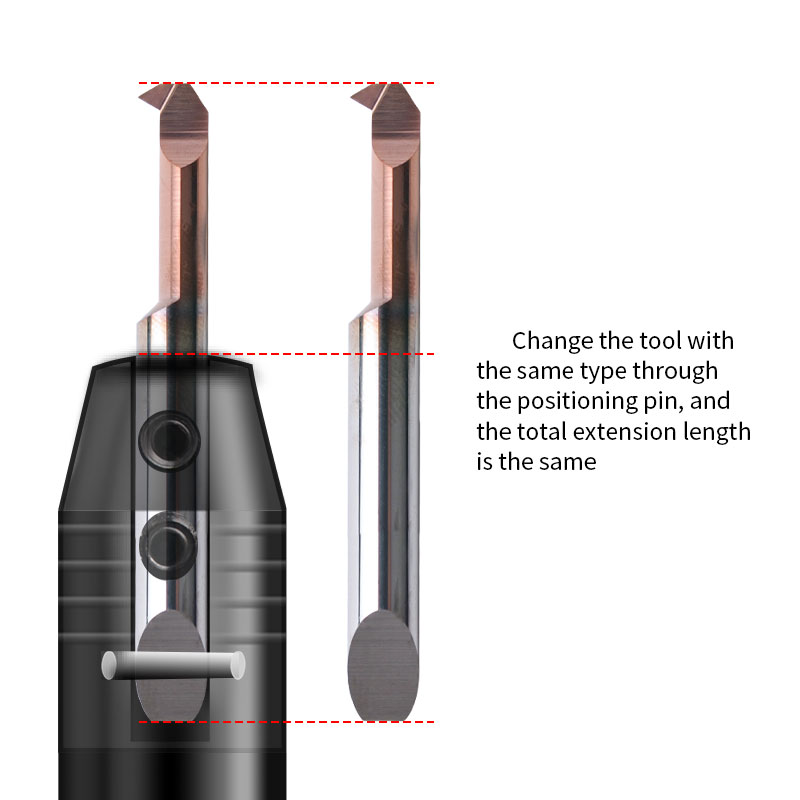
Setup accuracy is just as important as programmed parameters. Precision collets, hydraulic holders, or shrink-fit systems are commonly used with precision boring cutters to maintain concentricity and reduce clamping distortion. In micro boring, the holder is part of the cutting system, not just a mounting accessory.

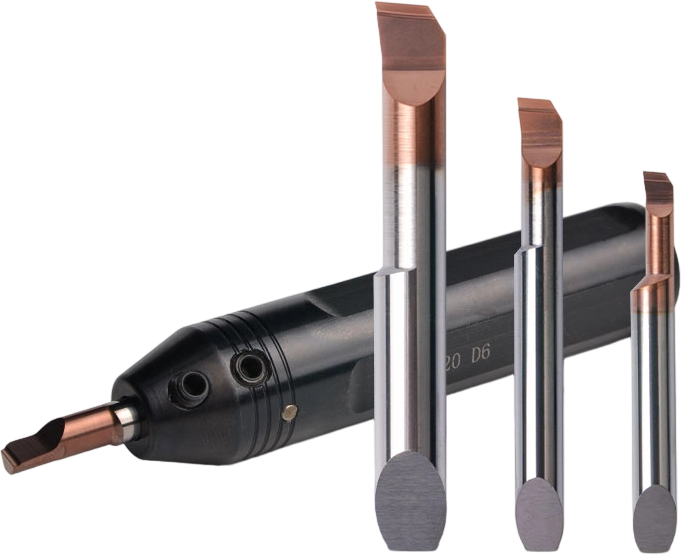
small boring tool

Common Failure Patterns with Micro Boring Cutters

Failure modes in micro boring cutters tend to repeat across applications. Chatter marks inside the bore usually indicate insufficient rigidity, excessive overhang, or excessive speed. Edge chipping often points to vibration, interrupted entry, or brittle edge preparation.

Built-up edge is frequently seen when machining aluminum or low carbon steels with insufficient lubrication or inadequate edge sharpness. Sudden breakage is commonly linked to runout or hidden vibration rather than excessive programmed load. Reading wear patterns under magnification is a standard practice among experienced tooling engineers to diagnose these problems accurately.

Industry Applications of Micro Boring Cutters

Micro boring cutters are essential across multiple high-precision industries. In medical manufacturing, they are used for micro fluid channels, implant interfaces, and instrument components. In watch and instrument production, they finish miniature bearing bores and jewel seats where concentricity is critical.

Aerospace suppliers use micro internal boring tools for sensor housings and fine mechanical features. Electronics and connector manufacturers rely on them to maintain alignment and fit in dense micro assemblies. Across all these applications, bore accuracy directly influences product reliability and assembly success.

Conclusion: Micro Boring Cutters Require a System Approach

Micro boring cutters operate at the edge of mechanical tolerance where geometry, material, and rigidity interact within very small margins. Successful results come from treating the process as a complete system that includes the cutter, holder, collet, machine structure, and cutting parameters.

From a professional standpoint, the most reliable micro boring operations combine fine-grain carbide tools, minimal overhang, high-precision clamping, and conservative cutting strategy. When rigidity and runout are controlled, micro boring cutters consistently deliver accurate sizing, stable performance, and high-quality internal finishes — even in the most demanding micro machining environments.

Ethan Walker graduated from the University of Sussex with a master’s degree in Mechanical Engineering, specializing in precision machining and advanced manufacturing technology. After graduation, she spent the next six years working as a senior me...